

Professional PDF Remediation Services
Ensure your documents meet WCAG 2.2, Section 508, and PDF/UA standards. Our certified accessibility specialists remediate complex PDFs to deliver full compliance, usability, and information equity.
Iterators provides professional PDF remediation services delivered by Trusted Tester-certified and accessibility-credentialed professionals who transform inaccessible documents into fully tagged, screen-reader-compatible PDFs that meet WCAG 2.2, Section 508, and PDF/UA requirements. Accessible PDFs are increasingly essential for organizations subject to federal accessibility laws, state regulations, government procurement requirements, and legal or reputational risks associated with inaccessible digital content.
Iterators remediates government publications, healthcare materials, legal disclosures, financial documents, educational content, and other complex PDFs, including forms, tables, multi-column layouts, and documents with images or interactive elements. This guide explains what PDF remediation involves, which accessibility standards apply, how remediation costs are determined, what the remediation and testing process involves, and what to look for when evaluating a qualified PDF remediation provider.
Understanding PDF Remediation & Accessibility Standards
Accessible documents are no longer optional. Federal regulations, state requirements, and corporate accessibility standards require PDFs to be fully compliant with WCAG 2.2, Section 508, and PDF/UA.
Iterators provides expert PDF remediation services delivered by Trusted Testers and accessibility-certified professionals. Our team transforms inaccessible PDFs into fully tagged, screen-reader compatible, standards-compliant documents — without altering your visual design.
Whether you manage government publications, healthcare materials, financial disclosures, or educational content, we ensure your documents are accessible to users with visual, cognitive, and mobility disabilities.
What Is PDF Remediation?
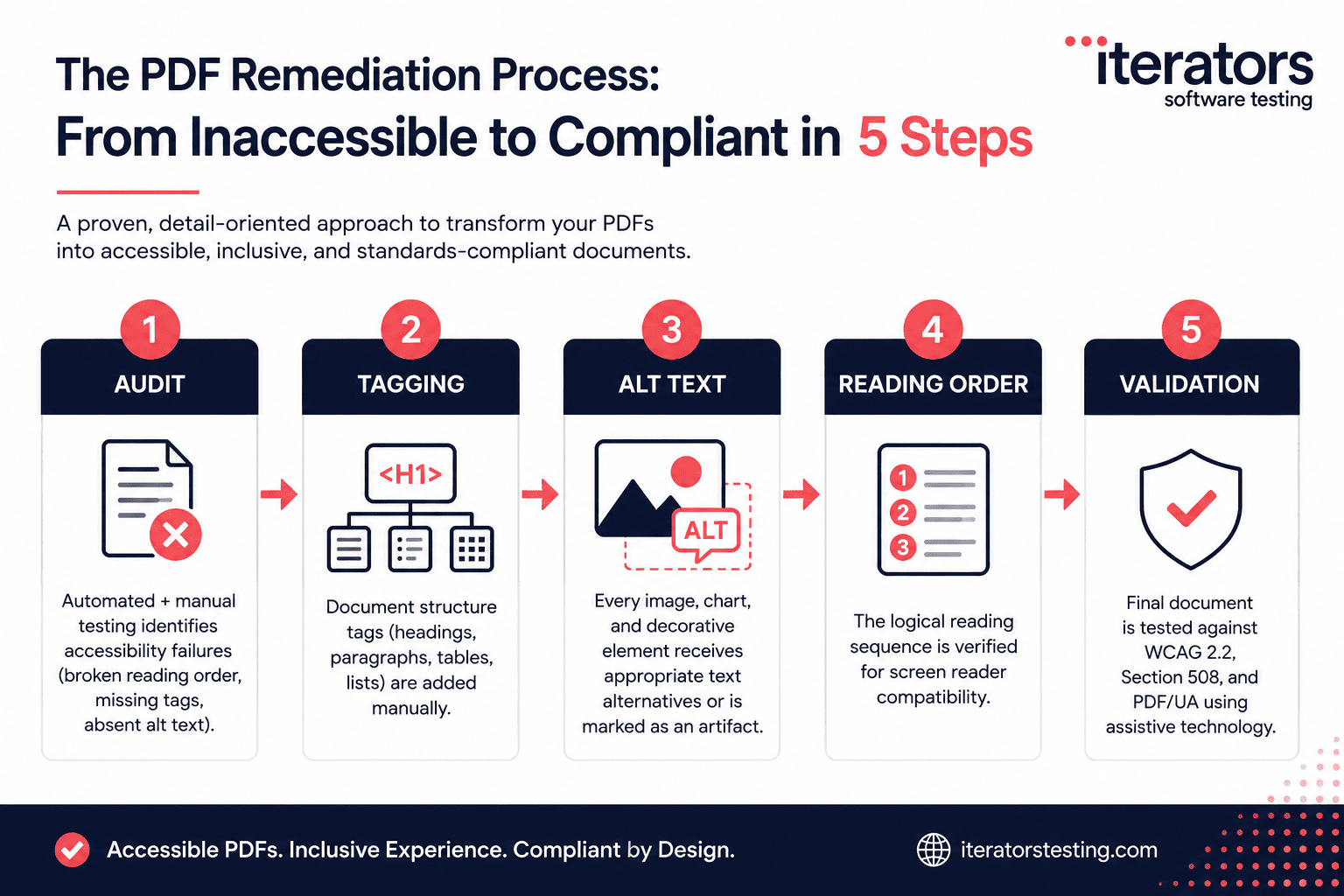
PDF remediation is the process of modifying a PDF document to ensure it is accessible and usable for individuals with disabilities. This includes adding semantic tags, correcting logical reading order, structuring headings and lists, providing alternative text for images, and ensuring compatibility with assistive technologies such as screen readers.
The remediation process begins with evaluating the document’s current accessibility status, identifying structural issues, and systematically correcting them to meet recognized compliance standards.
Key Points From This Video
• PDF remediation is the process of adding accessibility structure (tags, reading order, alt text) to a PDF document.
• Federal law requires accessible PDFs for government agencies, contractors, and federally funded institutions.
• WCAG 2.2, Section 508, and PDF/UA are the three primary compliance standards.
• Remediation preserves your document's visual design while making it readable by screen readers and assistive technology.
• Iterators LLC is staffed by Trusted Tester-certified professionals based in Boston, MA.
Regulatory Compliance for PDF Documents
Organizations are increasingly required to comply with:
- Section 508 (Federal accessibility requirements)
- The Americans with Disabilities Act (ADA)
- State-level accessibility mandates
- Corporate and procurement accessibility standards
Non-compliance can lead to legal risk, reputational damage, and accessibility complaints. A structured remediation process demonstrates your organization’s commitment to information equity.
PDF Accessibility Standards We Support
WCAG (Web Content Accessibility Guidelines)
WCAG provides the framework for making digital content perceivable, operable, understandable, and robust. For PDFs, this includes:
- Text alternatives for non-text content
- Keyboard navigability
- Proper heading structure
- Sufficient color contrast
PDF/UA (ISO 14289)
PDF/UA is the international standard for accessible PDFs. It requires:
- Logical reading order
- Proper tagging and document structure
- Accessible metadata
- Compatibility with assistive technologies
Accessible PDFs help organizations meet requirements under WCAG, Section 508, PDF/UA, and the ADA. Learn more about making PDFs ADA-compliant and the specific accessibility features required for compliant documents.
List of Features for PDF Accessibility
Our PDF remediation services include:
- Validation against Section 508, WCAG 2.2, PDF/UA 1.0, and HHS standards
- Full structural tagging and logical reading order correction
- Remediation of multi-page and complex document layouts
- Accessible tables, lists, forms, and interactive elements
- Accurate alt text for images, charts, and graphics
- Table of Contents (TOC) structuring and navigation enhancement
- Color contrast evaluation and correction
- Output delivery in accessible PDF and/or HTML formats
Every remediated file undergoes rigorous quality assurance testing using industry-standard accessibility tools and manual screen reader verification.
How We Handle Complex PDF Remediation
Logical Reading Order & Structured Tagging
We ensure documents follow a logical, hierarchical structure so assistive technologies interpret content accurately. Proper tagging of headings, paragraphs, lists, and tables creates a seamless experience for screen reader users.
Accessible Tables, Links & Navigation
Tables are structured with appropriate row and column headers to preserve meaning. Links use descriptive anchor text rather than generic labels. For long documents, we implement structured navigation and table of contents tagging.
Text Equivalents & Alt Text for Visuals
All meaningful images, charts, and graphics receive descriptive alternative text. Alt text is written to convey function and context — ensuring users with visual impairments receive equivalent information.
Forms & Interactive PDFs
Interactive PDF forms are fully navigable via keyboard. We ensure:
- Clear labeling of form fields
- Logical tab order
- Accessible validation messaging
- Screen reader compatibility
Complex Layouts & Multi-Column Documents
For documents with multi-column layouts or embedded graphics, we restructure content to maintain proper reading order and structural clarity without altering visual design.
Our PDF Remediation Process
- Accessibility Audit
We assess your existing PDFs against WCAG, Section 508, and PDF/UA requirements. - Structured Remediation
Our team applies semantic tagging, logical reading order adjustments, alt text creation, and structural corrections. - Manual & Automated Testing
We validate documents using assistive technologies and industry-recognized tools. - Compliance Documentation
When required, we support VPAT and Accessibility Conformance Reporting (ACR).
Organizations often have questions about timelines, compliance standards, quality assurance, and remediation workflows. We've compiled answers to common remediation questions to help clients better understand the remediation process and what to expect.
Testing & Validation for PDF Remediation Compliance
Ensuring accessibility requires more than automated scanning.
Our validation process includes:
Manual Testing
- Screen reader navigation review
- Structural verification of headings and tags
- Table and form functionality testing
- Color contrast validation
Automated Testing Tools
We leverage industry-standard tools such as accessibility checkers and compliance scanners to identify structural and technical issues efficiently.
Assistive Technology Testing
Where appropriate, we evaluate usability using assistive technologies to confirm real-world accessibility.
This combined approach ensures documents meet both technical standards and user experience expectations.
Our team combines expert manual remediation with specialized software to ensure documents meet WCAG, Section 508, and PDF/UA requirements. If you're evaluating software solutions, see our PDF remediation tools comparison for an overview of common remediation platforms and best practices.
PDF Remediation Services in Boston, Massachusetts
Iterators is a Boston-based, SBA-certified Women-Owned Small Business (EDWOSB) providing professional PDF remediation services to organizations throughout Massachusetts and nationwide.
Our in-house accessibility specialists support government agencies, healthcare providers, financial institutions, and educational organizations in the Greater Boston area seeking WCAG 2.2 and Section 508 compliance.
While we serve clients across the United States, our Boston roots reflect our commitment to accessibility, information equity, and high-quality compliance services.
Why Choose Iterators for PDF Remediation?
- Trusted Testers certified by the Department of Homeland Security
- ISTQB-certified testing professionals
- SBA-certified Women-Owned Small Business (EDWOSB/WOSB)
- In-house remediation specialists based in Massachusetts
- Proven expertise across government, healthcare, finance, and education sectors
Accessible documents reduce legal risk, expand audience reach, and demonstrate your commitment to digital equity.
Contact our accessibility team today to discuss your remediation needs.
Frequently Asked Questions About PDF Remediation
-
What is PDF Remediation?
PDF remediation is the process of adding accessibility tags, structure, and metadata to an existing PDF document so that it can be read and navigated by screen readers, assistive technologies, and automated accessibility checkers. Remediation does not change how a document looks - it adds an invisible structural layer (tags, reading order, alt text for images, table headers, form field labels) that enables assistive technology users to access the content. An untagged or improperly tagged PDF fails accessibility compliance regardless of its visual design.
-
How much does PDF remediation cost?
PDF remediation cost depends primarily on document complexity, page count, the presence of tables and forms, the number of images requiring alt text, and required turnaround time. Simple text-heavy documents cost less to remediate than complex multi-column layouts, scanned documents, or form-heavy files. Requesting a sample document assessment from your provider before committing to a large project is standard practice.
-
How long does PDF remediation take?
Timeline depends on document complexity and volume. Rush remediation is available for compliance deadlines - discuss timeline requirements with your provider at the outset so they can allocate capacity accordingly.
-
What is the difference between PDF remediation and PDF accessibility?
PDF accessibility is the goal - a document that fully meets WCAG 2.2, Section 508, and/or PDF/UA requirements and is usable by people with disabilities. PDF remediation is the process used to achieve that goal on existing, inaccessible documents. Creating a new document with accessibility built in from the start is called accessible document authoring; remediating an already-published document is PDF remediation.
-
Does my organization need PDF remediation for Section 508 compliance?
If your organization is a federal agency, federal contractor, or recipient of federal funding, Section 508 of the Rehabilitation Act requires that electronic content - including PDFs - be accessible to people with disabilities. This applies to documents published on websites, distributed digitally, or used in internal operations. PDFs that were created before current standards were in place, converted from scanned documents, or exported from source files without accessibility settings enabled typically require remediation to achieve compliance.
-
What WCAG 2.2 criteria apply to PDF documents?
WCAG 2.2 (Web Content Accessibility Guidelines, version 2.2) applies to digital content including PDFs. The most relevant criteria for PDF documents address text alternatives for non-text content (Success Criterion 1.1.1), meaningful reading and navigation order (1.3.2), clear heading structure (1.3.1), accessible forms and form labels (1.3.1, 3.3.1 - 3.3.2), sufficient color contrast (1.4.3), and keyboard accessibility (2.1.1). Proper tagging is the technical mechanism for satisfying most of these criteria in a PDF.
-
What is PDF/UA, and is it the same as WCAG compliance?
PDF/UA (ISO 14289-1) is a technical standard specifically for accessible PDFs. It specifies the tagging structure, metadata, and authoring requirements that a PDF must meet to be fully accessible. WCAG is a broader content accessibility standard that applies across web and digital formats. They overlap but are not identical - a PDF can meet WCAG Level AA and still fall short of full PDF/UA conformance, and vice versa. For federal procurement and government use cases, PDF/UA is increasingly required alongside Section 508.
-
Can I use automated tools to remediate PDFs myself, or do I need a professional?
Automated tools such as Adobe Acrobat Pro's accessibility checker and Make Accessible wizard can identify and fix some accessibility issues - primarily missing tags, basic reading order, and simple alt text prompts. However, automated tools consistently miss complex reading order issues, table structure errors, decorative image designation, form field logic, and document language assignment. Industry research estimates that automated tools address 30 - 40% of accessibility issues in typical documents; the remainder require manual remediation by a trained professional. For documents that must pass a formal accessibility audit or legal review, professional remediation is required.
-
What types of documents and industries most commonly need PDF remediation?
PDF remediation is most frequently required in federal and state government (regulations, forms, publications), healthcare (patient materials, consent forms, clinical documents), legal (court filings, contracts, disclosure documents), financial services (statements, prospectuses, regulatory filings), and higher education (course materials, research publications, student-facing documents). Any organization subject to Section 508, the Americans with Disabilities Act (ADA), or comparable state or international accessibility law and that publishes or distributes PDFs should have a remediation plan in place.
-
What credentials should I look for when evaluating a PDF remediation provider?
Look for providers whose staff hold recognized accessibility credentials - the DHS Trusted Tester Certification (issued by the U.S. Department of Homeland Security) is the benchmark for Section 508 testing and is the credential Iterators LLC staff hold. Other relevant credentials include IAAP CPACC (Certified Professional in Accessibility Core Competencies) and WAS (Web Accessibility Specialist). Beyond credentials, ask for sample remediated documents, request a test remediation of one of your own files before committing to a large project, and confirm that the provider tests output with actual screen reader software (JAWS, NVDA, VoiceOver) rather than automated checkers alone.

About the Author: Jill Willcox
Jill Willcox is the Founder and Managing Member of Iterators LLC, an SBA-certified Women-Owned Small Business specializing in accessibility testing and remediation. With a professional background rooted in accessibility and removing barriers for people with disabilities, Jill leads Iterators in delivering WCAG 2.2, Section 508, and PDF remediation services for businesses and government organizations.